
EdReports Pre-K Reviews: Frequently Asked Questions
Explore answers to common questions about EdReports pre-K curriculum reviews, including timelines, domains addressed by the reviews, and research foundations.
Related resources:
- Explore our pre-K review criteria and learn more about our pre-k reports,
- For general questions about EdReports, see our main FAQs page.
Last updated: September 2026
Page contents
- Understanding Pre-K Reports and Ratings
- Using and Interpreting Reviews
- Pre-K Review Tools and Criteria
- Review Process and Methodology
- Scope of Reviews
- Definitions and Landscape
- Additional Topics and Considerations
Understanding Pre-K Reports and Ratings
Q: What is the pre-K report structure?
A: EdReports pre-K reports are organized into three sections, called gateways, each focused on a key aspect of quality. Each gateway includes detailed criteria and indicators, along with evidence explaining strengths and gaps. Reports provide ratings at the criterion and indicator levels to help users understand specific strengths and gaps across the materials.
Q: How are ratings determined in EdReports pre-K reviews?
A: Ratings are based on a structured, rule-based process rather than averages or percentages. Reviewers collect evidence at the indicator level using detailed rubrics that define what it means to meet, partially meet, or not meet expectations.
These indicator ratings are then combined using defined scoring rules to determine criterion ratings. For example, a criterion may meet expectations only if at least half of its indicators meet expectations and none do not meet expectations.
Q: What are some of the primary differences between EdReports pre-K and K-12 reviews?
A: EdReports pre-K reports build on the same core approach used in K–12 reviews, including a rigorous, educator-led process, evidence-based criteria and indicators, and a structured gateway, criterion, and indicator framework.
There are also important differences that reflect the nature of early learning. Pre-K reports are organized around developmental domains and whole-child learning, rather than subject-specific standards alone. They focus on how materials support integrated development across areas like language, math, and children’s ability to build relationships, regulate emotions, and engage with others.
Pre-K reports do not include a single overall or series-level rating, or gateway-level ratings. Reports are organized into three gateways, but ratings are provided at the criterion and indicator levels, helping users examine specific strengths and gaps across the materials rather than rely on a gateway or series summary scores.
In addition, pre-K gateways are not conditional. Every program is reviewed across all three gateways, recognizing that each area is essential to understanding overall quality.
Finally, pre-K reports use ratings Meets Expectations, Partially Meets Expectations, or Does Not Meet Expectations, determined by defined scoring rules rather than numeric scores or averages (discussed above).
Q: What updates did EdReports make to pre-K reports in September 2026?
Following the release of our inaugural pre-K reports in April 2026, we gathered stakeholder feedback and tested usability improvements with website users and pre-K experts. In September 2026, we made two focused updates.
The review criteria, underlying evidence, and educator-led review process did not change, and we applied the updates consistently across all three inaugural reports using existing evidence.
First, we replaced gateway ratings with a criterion-level overview, giving users a more detailed picture of strengths and gaps across the materials.
Second, we more directly connected curriculum design and content ratings for each domain, such as math, science, and language and literacy. These are still rated separately, but the curriculum design rating now also factors into the corresponding domain content rating, reflecting that strong design is foundational to high-quality learning experiences.
Learn more about pre-K report updates.
Q: Why change a report rating after it has already been published?
Changing a published rating is not something we do lightly.
It’s important to understand that the review criteria and collected evidence were not changed. Rather, we identified a limitation in how existing evidence was aggregated into a criterion rating and determined that the updated approach provides a more accurate representation of that evidence.
The updated scoring rule was applied consistently across all three inaugural reports. Different programs saw different results because their underlying evidence was different, but the rule was the same for everyone.
The impact on published reports was limited. The scoring update did not change any criterion ratings in two of the three reports and resulted in one criterion rating change in the third, from Meets Expectations to Partially Meets Expectations. Each v1.0 report includes 15 total criterion ratings.
Learn more about pre-K report updates.
Q: Why make this change now after only three published reviews instead of waiting?
EdReports does not change a rating lightly. Because these concerns emerged early in the rollout of a new review area, EdReports believed it was important to address them now to deliver a stronger quality signal to the field rather than wait for the more in-depth refinement of its pre-K review criteria planned for late 2026 into 2027.
Q: Do you plan to make further scoring changes?
The September 2026 update was a focused change to how existing evidence is aggregated into ratings, addressing the most important learning from the inaugural reviews.
We are also undertaking more in-depth work in late 2026 into 2027 to develop the next version of the pre-K review tools, including potential refinements to the review criteria, evidence guide, and scoring approach. All products previously reviewed are eligible for focused re-reviews on the updated tool if substantive changes have been made to the materials.
Our goal is to make thoughtful, durable improvements while continuing to learn from field needs and feedback.
Q: Why do pre-K reports not have gateway ratings? Will they be added later?
We initially included gateway ratings in inaugural pre-K reports, but feedback and user testing showed that gateway ratings did not provide the clearest representation of the detailed evidence underneath. As a result, we updated the reports to emphasize criterion- and indicator-level findings instead, which provide a more detailed picture of a program’s strengths and gaps.
Future design choices will center what is most clear and usable for educators and stakeholders.
Q: Why do curriculum design ratings influence domain-specific content ratings?
The v1.0 pre-K review tools were designed to examine content and curriculum design as distinct aspects of quality, including how learning is intentionally organized and sequenced over time. Through feedback from early childhood education experts and website users, we learned that many users wanted a clearer connection between these two aspects of quality and that the purpose of the distinction was not always clear.
The domain-specific indicator ratings in Criterion 2.1, Curriculum Approach and Design, now determine the maximum rating the corresponding domain-specific criterion (2.2-2.7) can receive. This better reflects the principle that strong content and strong curriculum design work together to create high-quality learning experiences.
Learn more about pre-K report updates.
Back to top of page / contents
Using and Interpreting Reviews
Q: Are these reports designed to act as recommendations for which curriculum to adopt?
A: No. EdReports reviews are not recommendations or rankings. They are designed to provide transparent, evidence-based information about the quality of instructional materials. The goal is to support educators and leaders in making informed decisions, not to prescribe a single “best” program.
Curriculum selection should reflect local priorities, context, and student needs. EdReports reviews and review tools are most useful when used alongside educator expertise, implementation considerations, and other sources of information. By offering a shared framework for evaluating quality, the reviews help teams compare options and engage in more informed, collaborative decision-making.
Q: What should I do if my program isn’t reviewed yet?
A: You don’t need to wait for a review to learn more about curriculum quality. EdReports’ pre-K review criteria and evidence guides are available to support educators and local selection processes today. These tools provide a research-based framework that can help teams define quality, compare programs, and identify strengths and gaps, even for materials that have not yet been reviewed.
Educators can also use the criteria to guide conversations with publishers and ask more targeted questions about curriculum design, supports for diverse learners, and implementation. In this way, the value of EdReports extends beyond individual reports. The criteria themselves help build a shared understanding of what high-quality pre-K materials should provide.
Back to top of page / contents
Pre-K Review Tools and Criteria
Q: What are "review tools"?
A: Each set of EdReports review tools comprises two documents:
- A review criteria document identifying the “indicators,” or specific items, against which our educator reviewers evaluate the quality of instructional materials.
- An evidence guide elaborating details for each indicator including its purpose, information on how to collect evidence, guiding questions and discussion prompts for reviewers, and scoring criteria.
Q: What research and standards underpin EdReports pre-K review tools?
A: Our review tools are grounded in foundational research from the National Academies of Sciences, Engineering and Medicine (NASEM) report, A New Vision for High-Quality Preschool Curriculum, the Head Start Early Learning Outcomes Framework (ELOF), and other well-established studies in early childhood education.
Currently, there’s no single set of national early learning standards. However, individual states have developed early learning standards that encompass multiple areas of child growth and development. In drafting their standards, states often align to the Head Start ELOF. Generally, there is a high degree of similarity in the core developmental domains in states’ early learning standards.
Q: How were the pre-K review tools developed?
A: EdReports pre-K review tools were built on the research foundation that is described above. In addition, the tool was designed through a collaborative, educator-centered process. A multidisciplinary team—including early childhood educators, researchers, and system leaders— shaped the tools with insights from a national Listening and Learning Tour, advisory panels, and an educator working group. The tools undergo multiple rounds of testing and refinement to ensure they reflect the diverse needs of early learning communities and support informed decision-making about high-quality instructional materials.
Scope of Reviews
Q: What domains do EdReports pre-K reviews address? How do you review pre-K materials that only cover one or a few domains?
A: EdReports pre-K review tools are designed to evaluate instructional materials across the following domains: mathematics, language and literacy, science and engineering, social studies, social and emotional development, fine arts, and physical and motor development.
Some pre-K materials may cover all of these domains, while others may focus on just one or a few. Our educator reviewers evaluate materials based on the domains the publisher identifies, or “claims”, that the materials are intended to address, using the relevant elements of the review tools.
Q: Why were only a few programs reviewed at launch?
A: Typical for new review efforts, EdReports begins with a small number of widely used programs to establish a clear, high-quality standard and provide an initial signal to the field. Additional reviews are released over time on a rolling basis.
Importantly, the goal is not to cover the entire market at once, but to build a strong foundation for understanding quality. As coverage expands, more programs will be added, giving educators access to a broader set of independent, evidence-based information.
Q: Which pre-K curricula will you review next, and how will you decide? Can I suggest a curriculum for review?
A: EdReports is continuing to expand its pre-K reviews, with additional programs to be reviewed on a rolling basis. Programs are prioritized based on several factors, including relevance to the field, market share, and demand from educators and system leaders. We are in regular contact with curriculum publishers to assess readiness for review and to ensure we have access to complete, stable materials.
Our goal is to focus on materials that are widely used and representative of the broader pre-K landscape, so the reviews provide meaningful, actionable information for the field.
You can suggest materials for review via this form.
Back to top of page / contents
Review Process and Methodology
Q: Who are EdReports’ pre-K reviewers?
A: EdReports’ pre-K reviews are conducted by trained teams of practicing early childhood educators. These reviewers bring deep classroom experience and expertise across pre-K settings, including school-based, community-based, and Head Start programs.
Reviewers are selected through a rigorous process and participate in extensive training to ensure consistent application of the review criteria. Their work is grounded in evidence, collaborative discussion, and multiple rounds of calibration to ensure accuracy and fairness.
This educator-led approach is central to EdReports’ process. By drawing on the knowledge of those closest to teaching and learning, the reviews reflect both research and real classroom practice providing trusted, relevant information for educators and leaders.
Q: How does EdReports work with pre-K publishers?
A: EdReports maintains a collaborative, yet independent, relationship with pre-K publishers. We are in regular contact with publishers to determine readiness for review and to request access to complete materials.
During the process, publishers may provide an orientation to the review team and respond to clarifying questions. After a review is complete, they have the opportunity to share a written response and additional background information about their program.
To ensure objectivity, EdReports does not accept payment or gifts in exchange for reviews. Our strict conflict-of-interest policies are designed to protect the independence and credibility of every review.
Definitions and Landscape
Q: Why is EdReports reviewing pre-K materials?
A: Early childhood is a pivotal stage, laying the foundation for future learning and long-term success. Preschool enrollment is at record highs, and over $250 million is spent annually on pre-K curriculum, assessment, and professional development. However, as the National Institute for Early Education Research highlights, “early education opportunity in the United States still depends on your zip code.” Many young children from historically marginalized communities, including multilingual learners and those who experience poverty, do not have equitable access to achieve ‘kindergarten readiness.’
According to the National Academies of Science, Engineering, and Medicine, “curriculum—what and how children learn in a program—is a critical determinant of the quality and effectiveness of a preschool program.” Until now, there have been no independent reviews of pre-K instructional materials to inform high-stakes decisions around which curriculum to choose. Data and research make clear that the learning continuum begins before kindergarten, and that reality matters for the whole PK-12 field. Pre-K is a foundational phase in students’ development, and high-quality instructional materials are essential to anchoring strong early learning experiences and supporting readiness for what comes next across the PK-12 continuum.
Q: What does EdReports mean by "pre-kindergarten"?
A: EdReports uses the term pre-kindergarten to describe the year of student learning before kindergarten. While many publishers of early childhood instructional materials provide products across the 0-5 age range, EdReports currently focuses on materials designed for learners preparing for kindergarten in our inaugural reviews.
Q: What are the national pre-K standards and domains?
A: Currently, there’s no single set of national early learning standards. However, individual states have developed early learning standards that encompass all areas of child growth and development. Most state standards are aligned to five early learning domains that promote school readiness:
- approaches to learning and executive function
- social and emotional skills
- language and early literacy
- cognition and general knowledge
- physical well-being and motor development.
In drafting their standards, states often align to the Head Start Early Learning Outcomes Framework (ELOF) which was developed by the federal government and is required in Head Start programs across the country. Generally, there is a high degree of similarity of early learning standards across states.
Q: What are the main categories of pre-K materials?
A: There are two broad categories based on materials’ coverage of the five early learning domains (covered above) of “kindergarten readiness”:
- Comprehensive (aka “whole child”) instructional materials, which seek to cover all five early learning domains.
- Domain-specific instructional materials that focus on a subset of one to three domains.
Q: Do states have lists of approved pre-K instructional materials?
A: Yes. As of 2022, 19 states plus the District of Columbia and Guam had lists of approved early childhood instructional materials, although not all are mandated.
Back to top of page / contents
Additional Topics and Considerations
Q: How do EdReports pre-K reviews address the assets and needs of multilingual learners?
A: EdReports pre-K reviews explicitly examine how instructional materials support multilingual and dual language learners as part of the Diverse Learners criterion (1.2).
Within this area, reviewers look at how materials recognize and build on children’s assets, including home language, cultural identity, and prior knowledge. This includes whether bilingualism is treated as a strength and whether children have meaningful opportunities to use their language and see it reflected in the learning experience.
Reviews also consider how materials support access and language development. This includes the use of scaffolds such as visuals, modeling, and structured opportunities for language use, as well as guidance for educators on differentiating instruction across varying levels of language proficiency.
Together, this evidence helps educators understand how well materials are designed to support all learners in engaging with early learning experiences.
Q: How do EdReports pre-K reviews address various state policies around SEL and culturally responsive educative content?
A: We’re sensitive to the needs of decisions makers as they navigate various policy requirements. EdReports’ role is to provide transparent, research-backed evidence about quality and to help local leaders evaluate materials against their own priorities and context. In pre-K, those questions are closely tied to access, engagement, and whether materials are responsive to the children and communities they are meant to serve. The reports are designed to make that information visible so educators and decision-makers can weigh it thoughtfully in light of local needs.
Q: Will EdReports review pre-K assessments and professional development materials as well as instructional materials?
A: EdReports’ reviews of K-12 instructional materials include reviewing teacher supports and the system of assessments included as part of the materials and this same approach is reflected in our pre-K review tools. However, we do not currently review standalone assessment products or professional development programs.
Q: How will EdReports incorporate evidence of the effectiveness of pre-K programs in its reviews?
A: As with K-12 materials, there is currently very limited robust, independent evidence demonstrating the effectiveness of individual pre-K programs across multiple contexts. For that reason, EdReports reviews materials as they are designed, rather than how they are implemented in specific settings.
This approach reflects an important reality: selecting high-quality instructional materials is only the first step. The impact of any curriculum depends heavily on how it is implemented, including factors such as educator training, program supports, and local context, areas that fall outside the scope of a curriculum review.Publishers may submit additional information as part of the review process, but the primary focus remains on evaluating the quality of the materials themselves. At the same time, EdReports is continuing to explore ways to provide the field with richer information about evidence and effectiveness across PK-12 over time.
Related Resources

3 Reasons EdReports Is Launching Pre-K Curriculum Reviews
Find out how EdReports' pre-K curriculum reviews will promote access to high-quality materials and instruction for all of our youngest learners.

EdReports Expands Mission with First-Ever Pre-K Curriculum Review Criteria
Nationally recognized curriculum watchdog brings trusted evaluation to early learning, answering urgent demand for quality materials.
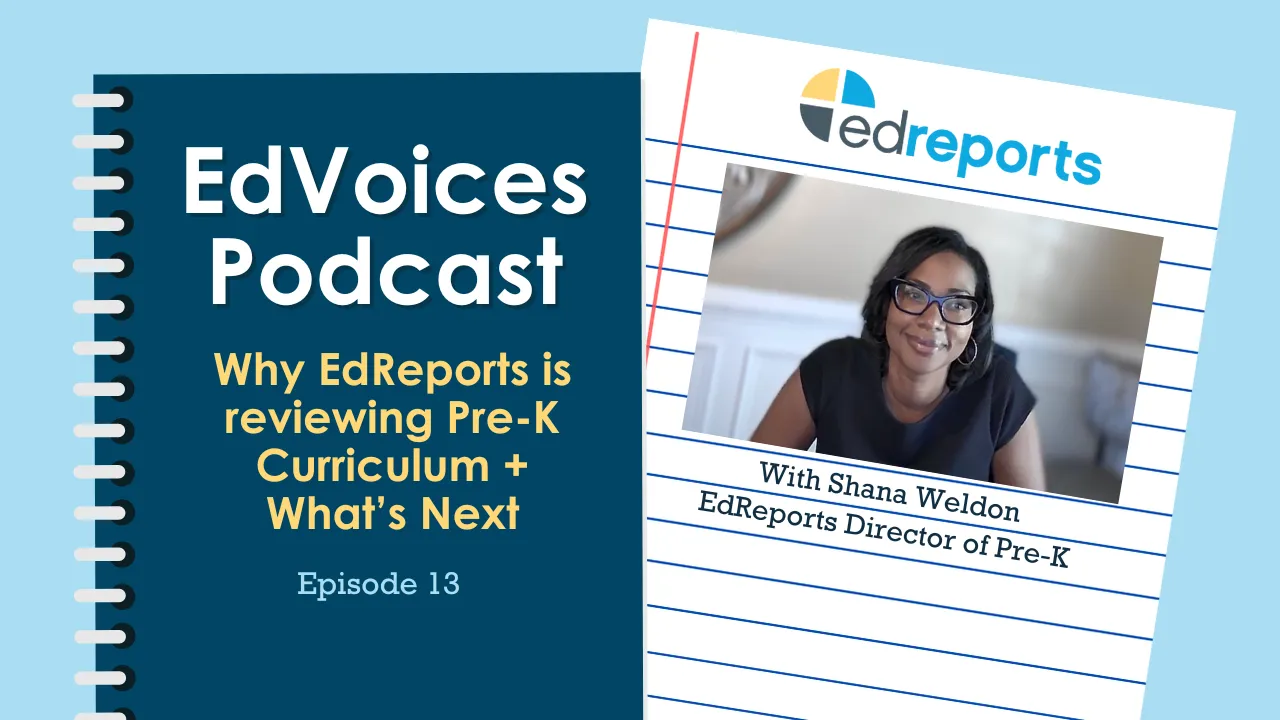
Watch: Why EdReports is Reviewing Pre-K Curriculum and What’s Next
EdReports director of Pre-K, Dr. Shana Weldon discusses the organization’s expansion into reviewing pre-K materials, and shares more about how and why we’ll be providing free, by-educator reports to help preschool educators get the materials they deserve.